
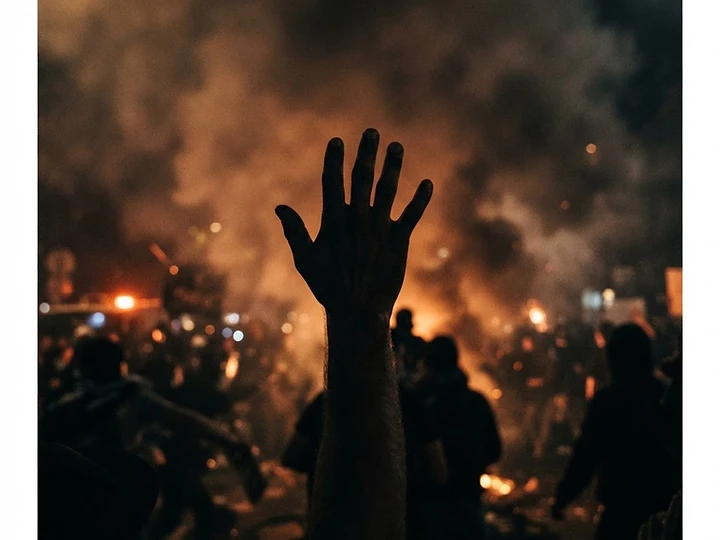
A Gesture That Travels
In a year of images, one recurs: the raised hand, open, alone against smoke or sky. It appears across continents and causes, detached from any single slogan, and it travels — across platforms, languages, borders — with a velocity that has surprised even those who study how symbols spread.
The Semiotics of the Palm
The open hand does several things at once. It is a refusal and an offering. It is unarmed — a deliberate counter to the machinery it confronts. And it is legible at a glance, in a thumbnail, at a great distance. It is, in the language of visual communication, a signal optimized for the medium that carries it.
It says nothing and everything. That is why it cannot be censored.
Why It Trended
The gesture trended not because any one protest did, but because the gesture itself became a trend — a signifier detached from its referents, circulating as a kind of shared grammar. Each shared image reinforced the last, until the hand meant the movement, and the movement meant the hand.
The Economy of the Image
There is a harder edge to the trend. A gesture that means everything can come to mean nothing — a logo worn smooth by repetition. Some organizers worry that the hand has become too easy to share, a substitute for the slower acts of organizing that actually change things. Others insist that a shared image is itself an act: a way of proving, across distance, that one is not alone.
What the Hand Holds
What endures is less the gesture than the need it answers — the need to be visible in an era that makes visibility both cheap and impossible to sustain. The raised hand will pass, as all symbols do. The restlessness it channels, this year, has not.


