
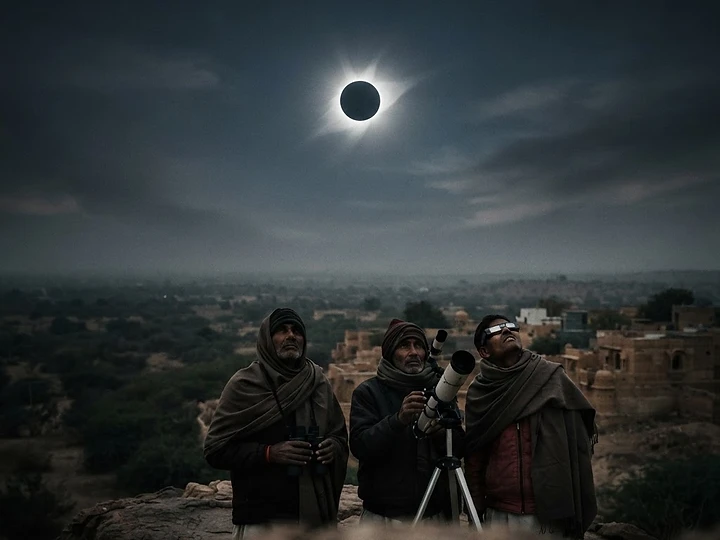
The Path of Totality\n\nThe astronomical event of the year is nearly upon us. On the night of August 12 and the early morning of August 13, 2026, a significant portion of the world will witness a 'Surya Grahan' or solar eclipse. While this particular eclipse is a total solar eclipse in parts of the Northern Hemisphere, its partial phases will be visible across vast stretches of Asia, including India. The path of totality will sweep across the Arctic Ocean, Greenland, Iceland, and Spain, but the global search interest is being driven heavily by the Indian subcontinent, where the event holds deep cultural and scientific significance. For nearly four and a half hours, the celestial dance between the sun, moon, and earth will captivate observers, prompting a massive surge in searches for timing, safety precautions, and viewing locations.\n\n## Advancing Solar Science\n\nFor the scientific community, the 2026 eclipse represents a rare opportunity to study the solar corona—the sun's outer atmosphere—which is usually obscured by the brilliance of the solar disk. Researchers from around the world are deploying instruments to the path of totality to capture high-resolution data on solar flares and coronal mass ejections. These observations are crucial for improving our understanding of space weather, which can have a direct impact on satellite communications and power grids on Earth. In India, the Indian Space Research Organisation (ISRO) and various astronomical societies are organizing public outreach programs to demystify the event and encourage scientific temper among the youth. The 2026 eclipse is not just a visual spectacle; it is a laboratory in the sky.\n\n## Astrological Anxiety and Cultural Traditions\n\nIn contrast to the scientific excitement, the eclipse also triggers a wave of astrological concern. In Vedic astrology, a Surya Grahan is often viewed as a period of 'Sutak,' a time of perceived spiritual impurity. Search trends in India show a high volume of queries related to the impact of the eclipse on various 'Rashis' (zodiac signs). Many traditional households follow specific rituals, such as fasting during the eclipse and performing cleansing baths afterward. This intersection of ancient belief and modern science is a hallmark of how astronomical events are experienced in the 24th century. While scientists focus on the corona, millions of others are consulting priests and astrological charts to navigate the perceived cosmic energies of the event. This duality ensures that the eclipse remains a top-tier trending topic across multiple demographics.\n\n## Preparing for the Darkened Sky\n\nAs the countdown to August 12 continues, the logistical preparations are reaching a fever pitch. From the sale of certified solar viewing glasses to the booking of 'eclipse flights' that promise a view above the clouds, the economic impact of the Surya Grahan is substantial. Health authorities are issuing stern warnings against looking at the sun with the naked eye, emphasizing that even a partial eclipse can cause permanent retinal damage. Meanwhile, in cities like Ujjain and Varanasi, which have long histories of astronomical study, thousands are expected to gather at observatories and riverbanks. Whether viewed through the lens of a telescope or the prism of tradition, the 2026 solar eclipse serves as a powerful reminder of our place in the cosmos—a moment of shared wonder that transcends borders and beliefs.
24H TRAJECTORY+1200%


