
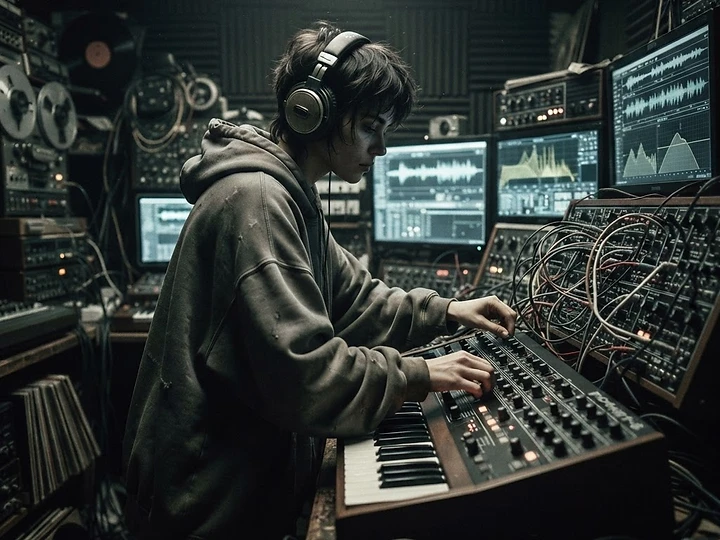
For the better part of the last decade, the digital world was defined by the 'lo-fi' aesthetic—stripped-back, repetitive, and designed to fade into the background of our lives. But as we move through the third quarter of 2026, a seismic shift is occurring in how we produce and consume sound. We are entering the era of Sonic Maximalism, a trend characterized by dense, multi-layered compositions that demand the listener's full attention.
The Death of Minimalism
Recent data suggests that the 'clean' and 'minimalist' sounds of the early 2020s are being replaced by a 'more is more' philosophy. According to Music Trends 2026: Hybrid Sounds, Nostalgia & AI, searches for 'maximalism' in stock music and production assets have surged by over 999 searches in the past 12 weeks alone. This isn't just a preference for louder volume; it's a demand for complexity. The rise of high-fidelity spatial audio and advanced wearable sound tech has made listeners crave textures that were previously considered 'too busy' for mainstream consumption.
This shift is visible across the industry. Creators are moving away from the predictable beats of the streaming era toward 'fusion music,' which has seen a 45% climb in search interest. This genre-bending approach blends disparate influences—think neo-classical strings meeting glitch-hop and traditional folk—into a single, cohesive wall of sound.
The Hybridization Engine
The primary driver of this maximalist wave is the evolution of AI hybridization. In 2026, the conversation has moved past the fear of AI replacing artists and toward how AI can augment human creativity. As noted in AI Music Industry Trends 2026: The Future of Artificial Intelligence in Music, the industry is embracing 'hybrid everything.'
Creators are no longer just using AI to generate a track; they are blending human performance with AI-assisted elements to produce music that adapts to context. Whether it is a cinematic brand video or an interactive game score, the ability to layer human emotionality with the infinite processing power of AI allows for a level of sonic detail that was previously impossible for a single producer to achieve. Tools like MusicGen and Soundverse are now being used to add 'impossible' layers—micro-textures and generative harmonies—that fill every corner of the frequency spectrum.
Emotional Intelligence as a Technical Skill
Perhaps the most fascinating development in this trend is the shift from genre-first thinking to mood-first production. In the past, a producer might set out to make a 'house track' or a 'pop song.' Today, the data shows that creators are searching for incredibly specific emotional states. According to Music Trends 2026, the top-requested moods in AI generation tools are 'soft,' 'emotional,' and 'dark,' often combined with technical descriptors like 'ambient strings' or 'rising tension.'
This suggests that emotional nuance has become a creative skill as essential as mixing or mastering. In a maximalist soundscape, the challenge is not just adding more layers, but ensuring that every layer serves a specific emotional purpose. Discoverability in 2026 is no longer driven by traditional genre labels but by the ability of a piece of music to match the hyper-specific 'vibe' of a TikTok edit or a virtual reality environment.
The Ethical Soundscape of Tomorrow
As we lean into this complex future, the industry is also grappling with the ethics of such high-density production. The AI Music Industry Trends 2026 report highlights the importance of 'Ethical AI Music Frameworks' to ensure that the data used to train these maximalist tools respects the rights of the original human creators.
As we look toward the end of the year, the trajectory of Sonic Maximalism shows no signs of slowing down. We are moving toward a culture where sound is not just a background element, but a rich, interactive, and deeply emotional experience. The 'lo-fi' girl has finally put on her headphones and turned up the complexity, ushering in a new age of human-machine symphony.


