
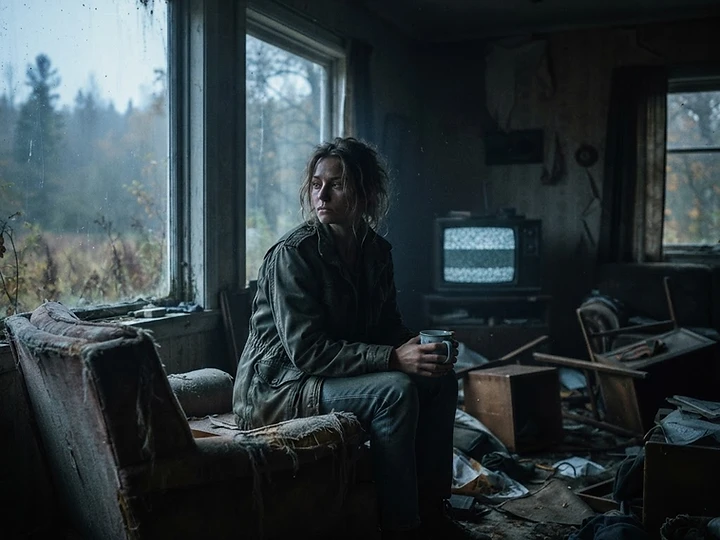
The Domesticity of Disaster
Released on August 7, 2026, Netflix’s The Last House has quickly ascended the streaming charts, not through the pyrotechnics of traditional disaster cinema, but through a chillingly quiet exploration of societal collapse. Starring Wagner Moura and Greta Lee, the film arrives at a moment when audiences seem less interested in the destruction of monuments and more preoccupied with the fragility of the living room. As the latest entry in the 'intimate apocalypse' subgenre, The Last House reflects a cultural shift toward stories that prioritize psychological realism over CGI-heavy spectacle.
The film follows a single family sequestered in a suburban home as an unspecified global catastrophe unfolds off-screen. By stripping away the 'eye in the sky' perspective common in Hollywood blockbusters, director and writer have crafted a narrative that mirrors the modern experience of crisis: a series of confusing notifications, flickering power grids, and the desperate attempt to maintain a sense of normalcy for one’s children while the world ends in the periphery.
The Power of the Moura-Lee Dynamic
Central to the film’s success is the chemistry between Wagner Moura and Greta Lee. Moura, who has spent much of the last decade playing high-stakes figures in international thrillers, delivers a performance of profound vulnerability. He portrays a father whose primary struggle is not against an external antagonist, but against his own mounting sense of helplessness. Opposite him, Greta Lee provides a grounded, sharp-edged performance that avoids the tropes of the 'grieving mother,' instead offering a portrait of a woman navigating the logistical and emotional labor of survival.
Critics have noted that while the film’s exploration of the underlying causes of its apocalypse—hinted to be climate-driven—remains somewhat shallow, the interpersonal dynamics are where the story finds its teeth. The tension does not come from the threat at the door, but from the slow erosion of the social contracts within the house. It is a study in how quickly the veneer of civilization thins when the Wi-Fi dies and the grocery stores empty.
A Mirror to 2026 Anxiety
The timing of The Last House is no accident. In a year defined by what cultural analysts call 'digital fatigue' and a heightened awareness of environmental instability, the film’s 'uncomfortably familiar' setting resonates deeply. Unlike the escapist fantasies of the 2010s, the 2026 audience is gravitating toward media that acknowledges the persistent, low-thrumming anxiety of the current era.
This trend is reflected in the broader entertainment landscape, where 'experiential' and 'authentic' narratives are outpacing traditional genre tropes. The Last House succeeds because it feels like a documentary of a nightmare we’ve all had. It taps into the collective fear that the end of the world won't be a bang or a whimper, but a long, quiet weekend where the lights just never come back on. The film’s refusal to provide easy answers or a heroic resolution is perhaps its most '2026' trait, acknowledging that in the face of systemic collapse, there are no protagonists—only survivors.
The Future of the Intimate Epic
As The Last House continues to dominate the cultural conversation, it sets a new benchmark for streaming originals. It proves that a $2.83 trillion entertainment industry can still find its most potent stories in the smallest spaces. The success of this film likely signals a wave of 'suburban survivalism' projects currently in development, as studios realize that the most terrifying monsters are not aliens or zombies, but the reflection of our own unpreparedness.
For Netflix, the film represents a strategic win in a landscape increasingly crowded by niche platforms and AI-driven content. By betting on high-caliber acting and a script that trusts the audience’s intelligence, they have captured the zeitgeist. The Last House isn't just a movie about the end of the world; it’s a movie about the end of the way we live now, and that is a story that 2026 is finally ready to hear.


