
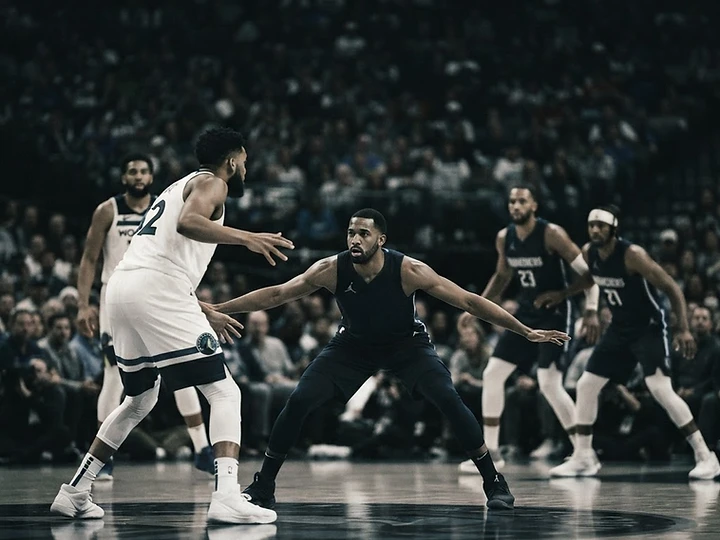
The Death of the Three-Point Obsession
In an NBA era defined by the long-range shot, the Dallas Mavericks’ 108-105 victory over the Minnesota Timberwolves in Game 1 of the Western Conference Finals felt like a strategic throwback. Despite shooting a dismal 24% from beyond the arc, Dallas managed to dismantle a Minnesota team that had just eliminated the defending champion Denver Nuggets. They did so by attacking the heart of the Timberwolves' defense, outscoring them 62-38 in the paint.
This victory was a masterclass in tactical adaptability. While the Timberwolves relied on the explosive athleticism of Anthony Edwards and the perimeter shooting of Jaden McDaniels, Dallas leaned into the methodical brilliance of Luka Doncic and Kyrie Irving. By prioritizing high-percentage looks at the rim over contested threes, the Mavericks exposed a critical flaw in Minnesota’s 'Twin Towers' lineup: speed of rotation.
The Kyrie Irving Paradox
Much of the pre-series narrative focused on whether Anthony Edwards could be contained. While Edwards remains the most dynamic young star in the league, Game 1 belonged to the veteran savvy of Kyrie Irving. Irving’s first-half explosion—scoring 24 of his 30 points in the opening two quarters—effectively neutralized Minnesota’s early momentum.
More importantly, Irving’s presence has fundamentally changed how Luka Doncic operates. For years, Doncic carried the heaviest usage rate in playoff history, often tiring in the fourth quarter. With Irving acting as a primary release valve, Doncic was able to conserve energy for a clinical 15-point closing stretch. This dual-threat backcourt creates a 'pick your poison' scenario for Minnesota head coach Chris Finch. If you double-team Doncic, Irving destroys you in transition. If you play them straight up, Doncic’s size and footwork allow him to manipulate the defense into submission.
Adjusting the Defensive Geometry
The Timberwolves now face a daunting task. Their defensive identity is built around Rudy Gobert’s rim protection, yet Dallas used that very presence against them, pulling Gobert out to the perimeter in switches and then attacking the vacated space. Minnesota’s offense also stagnated, with Karl-Anthony Towns struggling to find a rhythm against Dallas’s physical front line of Daniel Gafford and Dereck Lively II.
As the series moves forward, the pressure is on Minnesota to prove that their youthful energy can overcome Dallas’s tactical maturity. The Mavericks have demonstrated that in the high-stakes environment of the Conference Finals, the ability to control the pace of the game is more valuable than the ability to shoot the lights out. For the Timberwolves to survive, they must find a way to speed up a Dallas team that seems perfectly comfortable playing in the mud.


