

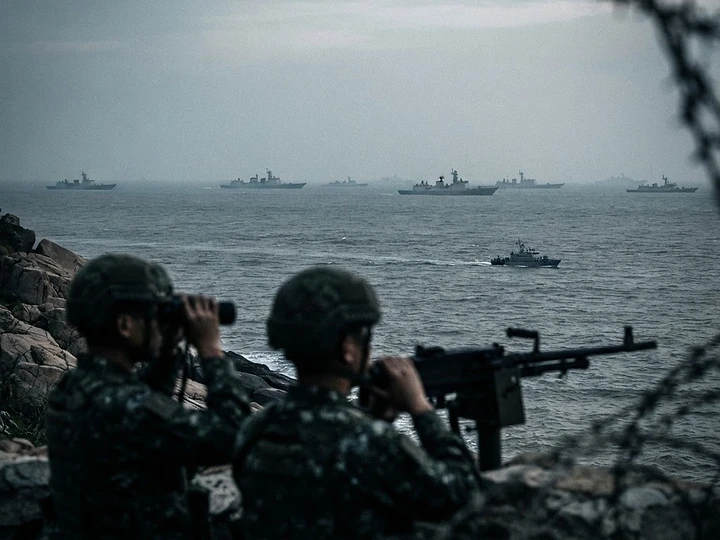
The Theatre of Deterrence\n\nIn the early hours of August 10th, the waters of the Taiwan Strait became the stage for a massive display of coordinated military might. Labeled as "precision strikes" and "sea-air joint patrols," these exercises represent the latest escalation in what defense analysts are calling the "new normal"—an era where military posturing is used as a primary tool of diplomatic communication. Trending search data from Taipei to Tokyo reflects a citizenry that is increasingly accustomed to, yet deeply wary of, these rhythmic displays of force. The August 10 drills are not merely a training exercise; they are a calculated message intended for both domestic nationalistic consumption and international strategic signaling.\n\n## Breaking the Median Line\n\nHistorically, the median line of the Taiwan Strait served as a psychological and tactical buffer, a line of self-restraint that maintained a fragile status quo. However, the current trending data shows a surge in queries related to "airspace incursions" and "median line violations." This suggests that the global public is paying close attention to the gradual erosion of these long-standing boundaries. Analysts at TrendFriend observe that the "Geography of Search" for this topic has expanded beyond specialized geopolitical circles and into the mainstream. This expansion is driven by a realization that a kinetic conflict in the Strait would not be a localized event, but a global economic catastrophe. The search interest is rooted in a collective anxiety about the fragility of peace in one of the world's most critical maritime corridors.\n\n## The Economic Shadow of Kinetic Threats\n\nWhile the headlines focus on missiles and destroyers, the "Economy" category of search reveals a different layer of the crisis. Search terms like "TSMC stock impact," "Taiwan shipping delays," and "global semiconductor supply chain" are spiking in tandem with the military news. This highlights the unique nature of this geopolitical tension: it is inextricable from the global economy. Taiwan’s dominance in high-end semiconductor manufacturing means that any military drill is perceived by markets as a threat to the global tech ecosystem. The August 10 exercises, occurring at a time of global economic sensitivity, have sent ripples through international markets, prompting a surge in searches for "safe-haven assets" and "supply chain diversification strategies."\n\n## The Psychology of Constant Tension\n\nOne of the most profound impacts of these recurring exercises is the psychological toll on the populations involved. In Taiwan, search trends for "civil defense manuals" and "emergency supply lists" have seen a steady, non-zero baseline growth over the last 24 hours. There is a perceptible shift from acute panic to a form of chronic vigilance. This "normalization of crisis" is a deliberate strategic goal for a regional power seeking to achieve its objectives through exhaustion rather than immediate conflict. The search data indicates that the world is no longer asking if these drills will happen, but rather how long the global system can withstand the strain of constant anticipation.\n\nAs the August 10 drills conclude their initial phase, the international community remains in a state of high alert. The intersection of military hardware and economic software has created a landscape where a search for a missile's range is just as common as a search for a tech company's quarterly earnings. The Taiwan Strait is no longer just a geography; it is a global barometer for the stability of the 21st century.
24H TRAJECTORY+350%